Warhammer 40K List Analysis That Shows Its Working
Eight capabilities, scored from the real weapon profiles in your army and ranked against thousands of reference lists. Find the hole in your list before your opponent does.
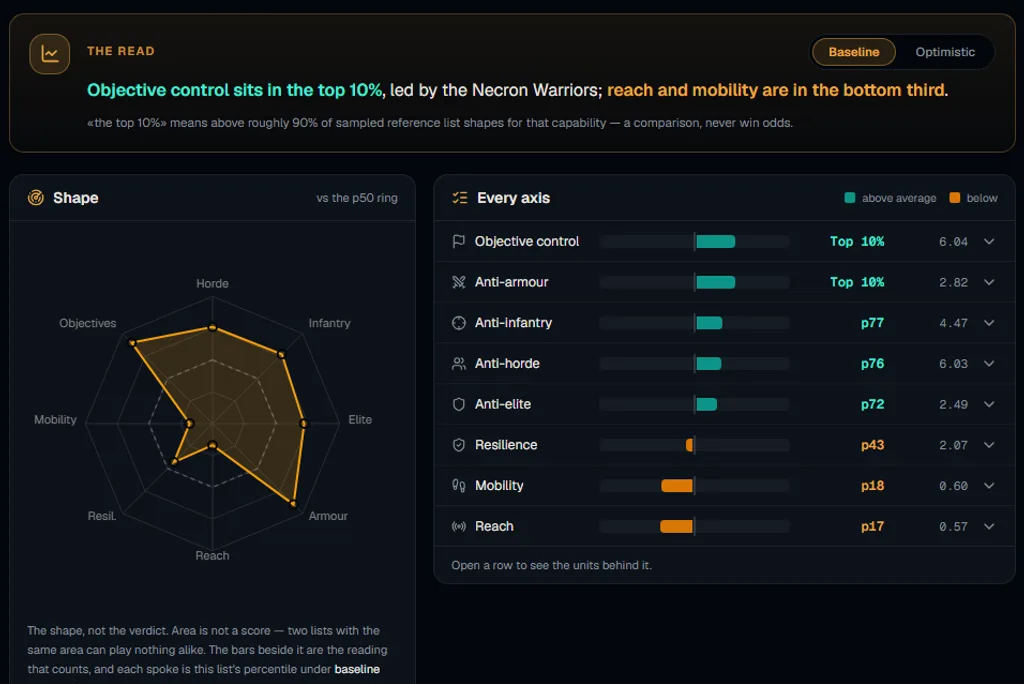
Eight Capabilities, One Shape
Every unit in your roster is run against a set of standard target archetypes using its actual weapon profiles, abilities and loadout. The result is eight scores — and the shape they make is your army.
More Than a Score
A number on its own is not advice. Every part of the page says what it means and which units produced it.
From List to Read in One Click
No exports, no spreadsheets, no setup. The analysis reads the list you already built.
Build or open a list
Any roster in GrimSlate works. Nothing to configure, nothing to export — the analysis reads the wargear you already chose.
Open the Analysis view
From the list, switch to Analysis. Every axis, the read and the readiness cards are computed in your browser, instantly.
Find the hole and fix it
Swap a unit, change a loadout, come back. The numbers move with your list, so you can see whether the change actually helped.
What It Is Not
It is not a win prediction, and it will never claim a matchup is won. The percentiles compare the shape of your list against 6,800 generated reference lists — 200 per faction, built from the same datasheets you build from — not against tournament results.
Terrain, mission scoring, stratagems, target priority and the person on the other side of the table decide games, and none of them are modelled. What the analysis does is answer a narrower question honestly: given the weapons in this list, what can it do — and what can it not?
Common Questions
Does GrimSlate tell me if my Warhammer 40K list is good?
It tells you what your list can do. GrimSlate scores eight capabilities from the real weapon profiles in your roster — anti-armour, anti-infantry, anti-horde, anti-elite, objective control, resilience, mobility and reach — and shows each as a percentile against a reference population. That reveals strengths and holes in the list's shape. It is not a win prediction: terrain, mission scoring, stratagems, and target priority are not modelled.
Where do the percentiles come from?
From 6,800 generated reference lists — 200 per faction, built from the same datasheets and points you build from, at 2,000 points. Your list is scored with the identical formula and placed against that population. So «top 10% for anti-armour» means your list beats roughly 90% of those reference lists on that axis. It is not tournament data.
Is the analysis free?
Yes. List analysis is free for every list, with no account required and no premium tier. It runs in your browser.
Can I analyse someone else's army list?
Yes. Every publicly shared list on GrimSlate has the same Analysis tab, so you can read a community list's strengths and weaknesses before copying it into your own collection.
How is this different from a damage calculator?
A damage calculator answers one question at a time: this unit, into that target. The analysis runs that maths across your entire list against a set of standard target archetypes, then compares the totals to other lists. Use the calculator for a single fight, the analysis for the whole army.
Which editions are supported?
The analysis reads whichever edition your roster uses, including current 11th Edition points and detachment rules, and it accounts for the army and detachment rules that change the maths.
What Does Your List Actually Do?
Free, instant, and it shows its working. Open a list and read it.